Pattern Field Theory
Pattern Field Theory
The Architecture beneath Reality
Pattern Field Theory derives physical reality through an ordered
constructive architecture in which identity, relation, substrate,
admissibility, persistence, manifestation, geometry, particles,
and fields arise through connected physical dependencies.
Pattern Field Theory research, publications, and development record
Current gravitational architecture
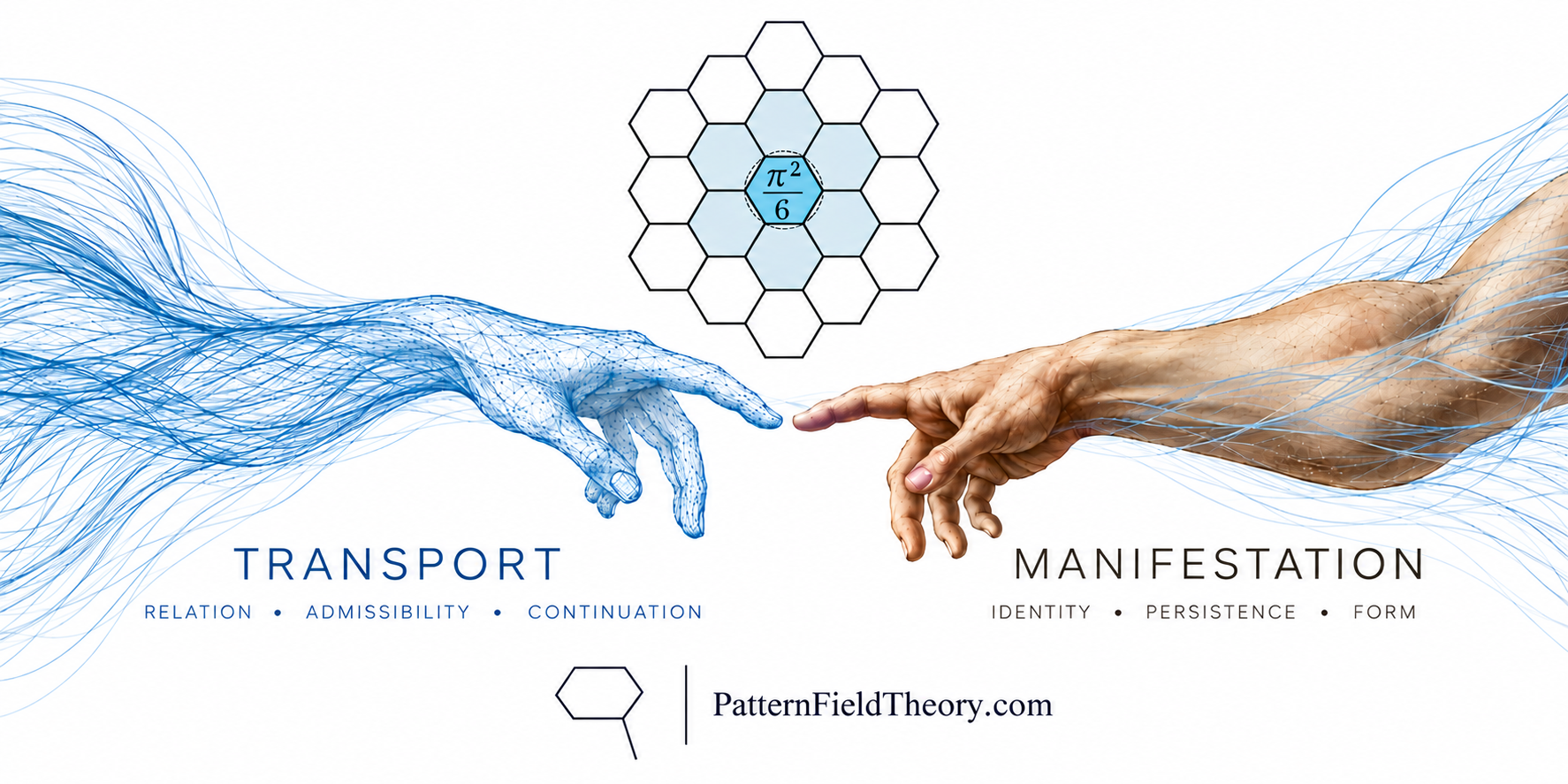
Gravity Is Transport
Gravity Is Transport
identifies gravity with Transport - the
relational continuation through which
physical states inherit direction,
sustain motion, and undergo gravitational
acceleration and free fall.
Building on
Einstein's Missing Extension (1931)
,
the paper develops the underlying relational
architecture through admissibility,
accumulated identity, loop holonomy,
and lattice isotropy.
Trajectory is understood through retained
directional state across successive
transport handovers. Free fall is examined
as unopposed admissible gravitational
Transport, while support establishes an
opposing continuation condition.
The paper develops mathematical and
computational connections between discrete
Transport, manifestation, gravitational
behaviour, and the emergence of effective
geometry.
Relation - Admissibility - Continuation
Starting Point
Physical reality requires construction
Pattern Field Theory begins with the minimum dependencies required for
anything physical to exist, persist, interact, and continue. Each later
structure inherits conditions established by earlier construction.
The current PFT causal ordering places geometry, particles, and fields
downstream of the identity and transport architecture that makes their
manifestation possible.
Identity
Relation
Inward Expansion
Substrate
Admissibility
Accumulated Identities
Closure / Persistence
Manifestation
Geometry / Particles / Fields
Ontological architecture
The Pattern Field Theory Starting Point
Pattern Field Theory begins with identity and relation and follows the
constructive dependencies required for physical reality to become
supportable, persistent, manifested, and observable.
Its current causal ordering is:
Identity > Relation > Inward Expansion > Substrate >
Admissibility > Accumulated Identities > Closure/Persistence >
Manifestation > Geometry/Particles/Fields.
Within this architecture, geometry is a downstream physical consequence.
Particles are manifestations of persistent accumulated identity.
Transport establishes continuation, admissibility constrains what can
continue, and interlayer identity coupling provides the depth-bearing
condition associated with manifestation.
Identity precedes the structures through which identity later manifests.
Relation establishes the first operative dependency between identities.
Inward Expansion develops the constructive depth from which substrate organization becomes possible.
The Substrate provides the physical availability within which admissible continuation can occur.
Accumulated Identities establish retained physical organization and persistence.
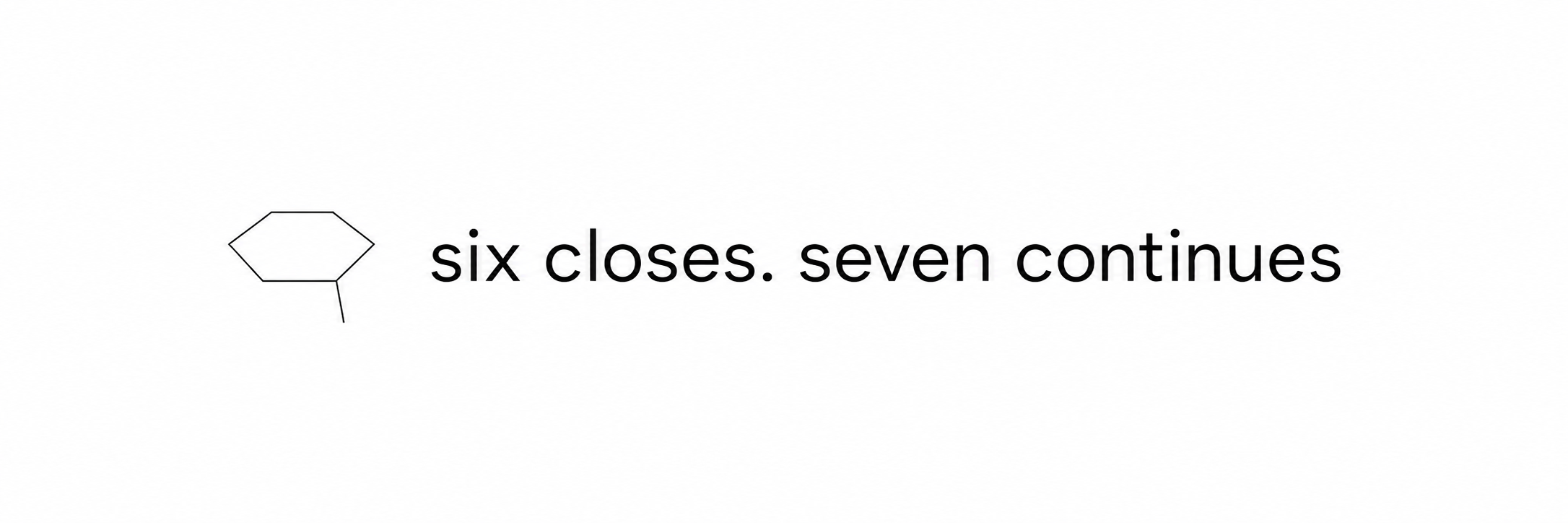
Six Closes. Seven Continues. expresses the Base-Pi closure and continuation architecture.
Manifestation is the measurable physical expression of committed and persistent identity relations.
Geometry, particles, and fields are later consequences of this constructive sequence.
Pattern Field Theory asks: where the Universe produces a physical result,
what must exist, what must occur, what must remain available, and what
ordered construction makes that result possible?
PFT's architecture, terminology, derivations, computational work, and
revisions are preserved through its publication and provenance record.
Pattern Field Theory research records:
PFT Zenodo community
·
Complete publication archive
Summary
Theory at a Glance
Pattern Field Theory (PFT) investigates how physical reality is constructed,
maintained, differentiated, and continued. PFT asks what must exist, and what must happen,
for the physical world we observe to be possible.
Its starting point is the dependency order required for stable physical
identity and observable physical organization. PFT asks how relation,
transport, identity, manifestation, and continuation become physically
established and how their accumulated structure produces the physical
world we observe.
Construction
Physical structure has an order of dependency
Identity, relation, Inward Expansion, substrate, admissibility,
accumulated identity, closure and persistence, and manifestation establish
the constructive path through which later physical organization becomes possible.
Starting architecture
Minimal constructive requirements
Each stage depends upon conditions established by earlier stages.
Later physical organization cannot precede the relations and transport
conditions required for its construction.
Central structural claim
Depth-bearing interlayer identity coupling
Flat 2D relational transport does not by itself produce manifestation.
Manifestation begins when the depth-bearing 1D(n) relation establishes
interlayer identity coupling across transport layers.
Physical identity
Identity Dynamics with Manifestation
A Universal Event contains Identity Dynamics and Manifestation as
inseparable aspects of one occurrence. Relational determination and
measurable physical expression belong to the same committed event.
Physical organization
Committed events accumulate structure
Populations of bounded Universal Events establish persistent identities,
transport relations, manifested depth, matter organization, Basin Dynamics,
and the measurable structures encountered at larger scales.
Testing
How PFT is tested
Mathematics formalises the architecture. Physical admissibility constrains
it. Reproducible calculation and observation test its consequences.
Quantitative claims require an observable result and an explicit failure
condition.
2D + 1D(n) ≡ Interlayer Identity Coupling (IIC)
≡ Manifestation
This identifies the depth-bearing coupling condition for manifestation.
Gravity is identified with Transport, through which admitted physical
states inherit direction and continue.
Interactive PFT demonstration
Transport Rendering
Transport Rendering visualizes a local sample of the Allen Orbital Lattice. Each visible vertex is a coordinate capable of hosting an identity. Base-Pi is a structural component of the transport architecture. The demonstration exposes substrate organization, Phi continuation, primary identity transport, IIC accumulation, selectable identity and composite representations, electromagnetic structure, and gravitation within the same local transport volume. Particle and composite bodies are visual representations only and are explicitly not to scale.
Transport Rendering
Local AOL sample · identity-hosting coordinates · Base-Pi structural component · transport · coupling · manifestation
Interactive demonstration
First Particle Principle
Any smallest admissible Base-Pi identity must be capable of initiating its own
successful universe when placed within the Metacontinuum.
The Base-Pi identity is not merely the first bounded identity produced inside
one particular universe. It is the minimum complete construction from
which a universe can begin.
It must therefore contain, in its own architecture, the requirements for
local closure, admissible continuation, differentiation, transport,
interlayer identity coupling, manifestation, persistence, and the later
construction of more complex identities.
No additional exceptional rule, externally supplied programme, or
universe-specific correction may be required. When an admissible
Base-Pi identity is placed within the Metacontinuum, its internal construction
rule must be sufficient to seed lawful universal development.
Safe equilibrium is the local condition that allows the
Base-Pi identity to become a stable bounded identity without terminating
continuation.
The First Particle Principle is the larger generative test:
any smallest admissible Base-Pi identity must contain sufficient constructive
architecture to begin and sustain the development of a universe when
instantiated within the Metacontinuum.
The first successful particle therefore contains not only the rule for its
own stability, but the minimum transferable rule for universal construction.
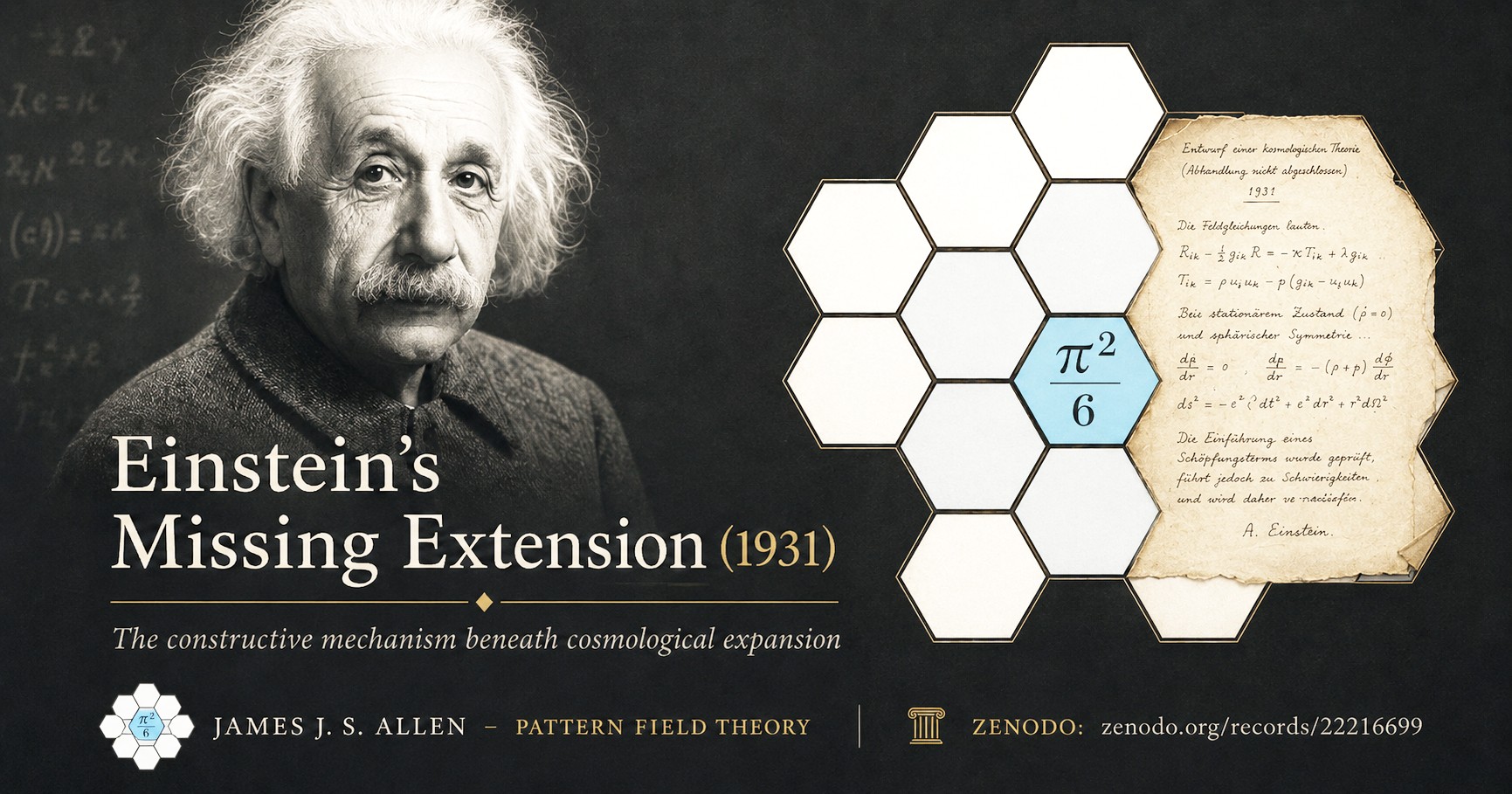
Einstein's Missing Extension (1931)
returns to the constructive problem beneath cosmological expansion:
what physical operation makes the next cosmological relational state
available?
The paper brings Einstein's abandoned 1931 cosmological construction,
Friedmann's dynamical cosmological scale, Lemaître's evolutionary
cosmology, and the Pattern Field Theory depth, EQUI, Allen Orbital
Lattice, Rationics, and continuation architecture into one
constructive problem.
Spacetime became the description of extension; Pattern Field Theory
asks for its construction.
Einstein's Missing Extension (1931)
The Constructive Mechanism Beneath Cosmological Expansion
From Discrete Transport to Continuum Cosmology
carries the construction into the discrete-to-continuum interface.
It develops the Allen Orbital Lattice coarse-graining map,
finite-resource EQUI admissibility, and the construction stack
connecting substrate transport to effective cosmological geometry.
The objective is to establish the mathematical handover between
discrete PFT transport structure and the smooth continuum description
used at cosmological scale.
Accounting for Unidentified Remote Effect
revisits Einstein's spukhafte Fernwirkung from the same
constructive standpoint. Rather than leaving apparently remote
correlation under the language of "spooky action", the paper asks
what interaction, transport, admissibility, retained-state, and
coupling architecture produces the observed effect.
Spukhafte Fernwirkung - no magic here, just unidentified
interaction.
Current Pattern Field Theory architecture
Recent formal publications
These papers establish current PFT results in Universal Events,
Identity Dynamics, Manifestation, interlayer identity coupling, gravitation,
and the construction of continuum-scale physical geometry.
Quantum gravity
Interlayer coupling
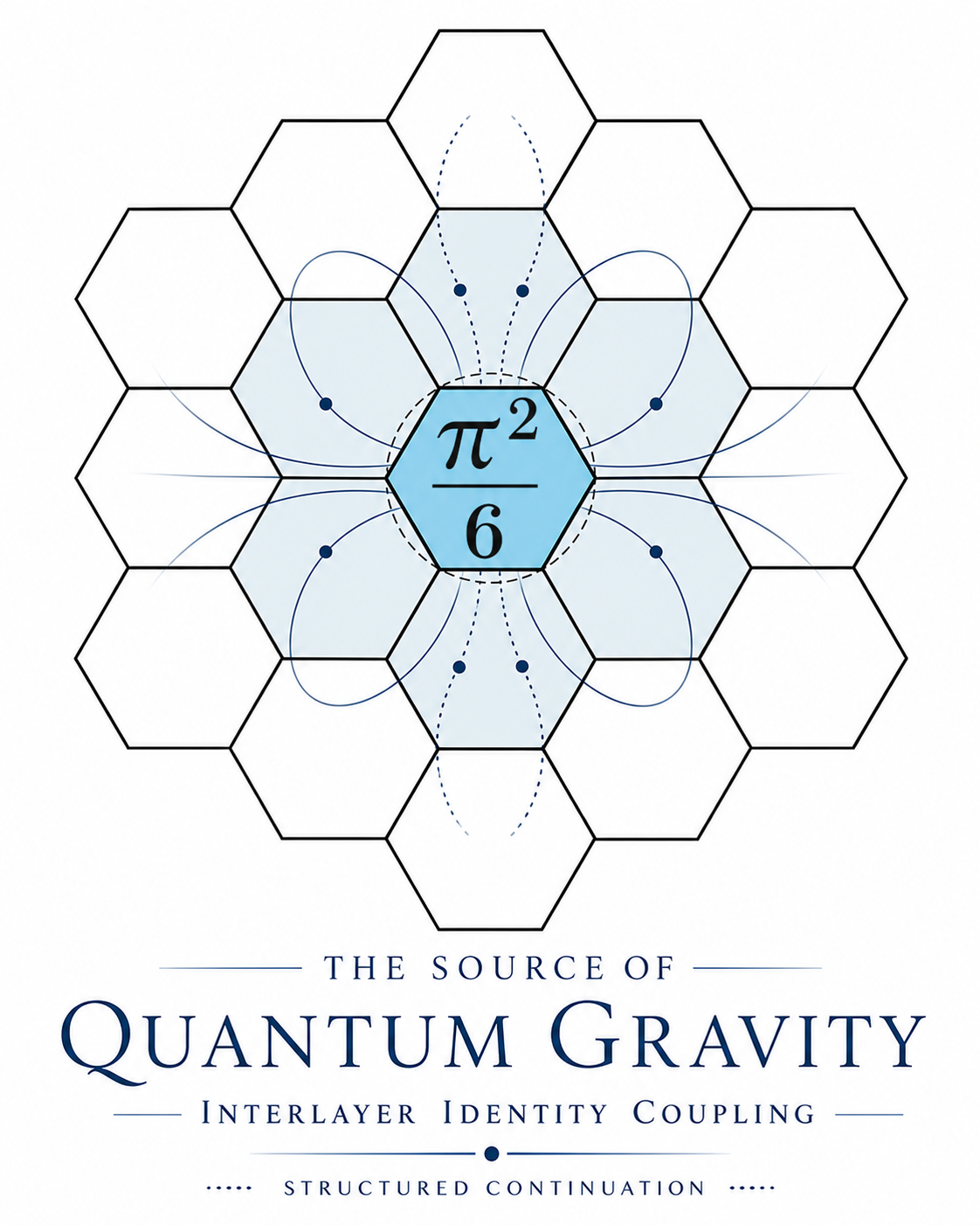
The Source of Quantum Gravity
Interlayer Identity Coupling
This publication identifies the depth-bearing structural condition
through which persistent identity becomes physically manifested across
transport layers.
It distinguishes flat relational transport from depth-bearing
interlayer identity coupling and develops the earlier
manifestation-gravitation formulation. The subsequent
Gravity Is Transport paper identifies gravity directly
with Transport.
2D + 1D(n) ≡ Interlayer Identity Coupling (IIC)
≡ Manifestation
Universal architecture
Identity Dynamics
The Universal Event
Identity Dynamics and Manifestation
This publication develops the Universal Event as the minimum complete
occurrence through which an operative identity participates in physical
reality.
Identity Dynamics and Manifestation are treated as inseparable aspects
of one committed event. The paper extends this architecture from
discrete physical commitment through bounded quantum execution and into
measurable continuum regimes.
A Universal Event contains Identity Dynamics and Manifestation as one
indivisible operative occurrence.
General relativity
Continuum recovery
Recovering the Einstein Field Equation of General Relativity
Substrate-Driven Geometry, Identity, Manifestation, Gravitation, and Energy Formation
This publication constructs the continuum handoff from the discrete PFT
substrate through AOL Rationic Unit accumulation, Interlayer Identity
Coupling, Manifested Depth, and Manifestation Load.
It identifies the Newtonian weak-field matching condition required for
the Einstein coupling and explicitly supersedes the earlier
Substrate Driven Geometry and Energy Formation record.
Discrete substrate → manifested depth → accumulated
manifestation load → effective geometry
Current access points
Formal publications
These are the official Pattern Field Theory publication repositories. They are being updated alongside the website archive and theory corpus, so coverage, ordering, metadata, and version status may change during the consolidation process.
Current overview
Pattern Field Theory
Substrate Physics
+
Engineering Physics
Pattern Field Theory approaches physical construction through
Substrate Physics and
Engineering Physics.
PFT investigates the constructive architecture of physical reality:
identity, relation, Inward Expansion, substrate, admissibility, accumulated
identities, closure and persistence, manifestation, and the downstream
construction of geometry, particles, and fields.
Its central engineering question is direct: if the Universe produces a
physical result, what must actually exist and occur for that result to
be possible?
Construction order matters. A later physical state cannot be supplied
independently of the structural relations, transport conditions, coupling,
and retained state required to produce it.
A principal discrete structure within PFT is the
Allen Orbital Lattice (AOL), a hexagonal admissibility
structure governing transport, stabilization, interlayer coupling,
persistence, and structural organization.
Substrate architecture
The Allen Orbital Lattice (AOL)
The AOL is the explicit hexagonal admissibility lattice through which Pattern Field Theory represents
discrete transport organization. In the current architecture it is downstream of the prior identity,
relation, Inward Expansion, and substrate dependencies. It defines structural conditions for
continuation, transport, identity persistence, and later effective geometry.
The lattice provides a minimal constructive environment: continuity, admissibility corridors,
stabilization basins, and relay partitions. These determine which transitions are physically
available and how identities remain coherent across events.
Historical development
Origins and Development of Pattern Field Theory
Pattern Field Theory (PFT) is the original theoretical framework of
James Johan Sebastian Allen. It developed from an
attempt to understand how physical structure can be constructed from
simpler prior conditions rather than assumed at the outset.
Allen's background is in software development, systems analysis,
telecommunications, technical education, and technical writing. His
early work with programming, binary representation, structured systems,
interfaces, state transitions, resource limits, and dependency order
strongly influenced the way PFT approaches physical theory. Allen is a
multilingual autodidact whose work draws on independent study,
engineering practice, computational investigation, technical writing,
and a broad programming background spanning multiple languages and
language families.
Allen's approach was also shaped by experiences far outside engineering.
A serious childhood brain injury, other life-threatening injuries involving
periods of disability, an upbringing in Northern Ireland during a period
marked by political and social violence, and an education frequently
experienced as violent all influenced the way he came to question received
structures, authority, and explanations that did not correspond with
observed reality.
These experiences, together with his engineering background, led to a
recurring question throughout the development of PFT: if the Universe
produces a physical result, what must actually exist and occur for that
result to be possible? Construction, transport, admissibility, identity,
persistence, manifestation, and continuation consequently became central
problems of the developing theory.
PFT was developed independently by Allen rather than emerging from an
institutional school or collaborative founding group. The framework has
evolved through testing, rejection, refinement, and consolidation into
its current constructive architecture.
That same concern with how systems construct, retain, interpret, and act
upon information has also carried PFT beyond foundational physics. Allen's
work extends into quantum computing, where persistence, admissibility,
coherence, and resource constraints become computational questions, and
into the study of consciousness as an emergent predictive capability
constructed by a biological system interacting continuously with its
environment.
Historical development.
This section records the conceptual lineage of PFT. Early terminology is
retained where it is necessary to describe that lineage, while later
formulations document the subsequent development of the theory.
The origin problem
The first physically admissible state
The earliest PFT question concerns the first transition into an
admissible physical state: what must occur for stable relation,
closure, transport, and persistent identity to become possible?
How can anything capable of possessing a state exist at all?
Early papers, including The Great Escape and
Before the Bang, frame the origin as a regime change from
non-state or non-closure to the first admissible closure. In the early
architecture, that closure is associated with π-seeded recurrence and
the establishment of a first persistent transport relation. The early
Pi-particle construction then supplies a bounded carrier through which
further relational structure can continue.
Origin problem
First admissible closure
Persistent transport relation
Pi carrier identity
AOL organization
Admissible continuation
Early construction objects
The first working vocabulary
The early corpus introduced a compact set of objects for expressing
closure, bounded identity, coherence, differentiation, and the emergence
of a discrete admissibility architecture.
Early architecture
First closure and Pi-particle
The first admissible closure establishes a persistent transport
relation. The Pi-particle is the early bounded carrier construction
associated with retained relational interval and continuation.
Discrete organization
Allen Orbital Lattice (AOL)
A prime-indexed hexagonal constraint architecture, modelled through
Eisenstein-integer structure, used to organize admissibility,
transport, stabilization, identity persistence, and later effective
geometry.
Differentiation
Equilibrion and Differentiator
Early commit, halt, and relational variation mechanisms used to
describe how structure can differentiate while remaining within
admissible coherence conditions.
Coherence
Phase Alignment Lock (PAL)
An early coherence condition associated with identity-stable
continuation and compatible relational persistence across successive
structural states.
Pre-dimensional null state
Metacontinuum
The Metacontinuum is the pre-dimensional null state: no identity,
no distinction, no relation, and no structure. It remains part of
the current PFT architecture. Logical Flow and the Logical Layer
are distinct constructs and do not replace the Metacontinuum.
Programme continuity
Coherence before continuum
The recurring commitment was that stable relation and continuation
must be constructed before continuum geometry can be used as an
effective physical description.
Foundational replacements
What the early programme set out to replace
PFT developed by moving explanatory priority away from supplied
continuum structures and toward explicit discrete construction and
transport relations.
Constructive development
From early geometric language to explicit construction
As PFT developed, explanatory priority moved toward increasingly explicit
construction, transport, admissibility, identity, and continuation.
Relational construction
→
Discrete transport and AOL admissibility architecture
Accumulated structure
→
Manifested depth and relational organization
Physical continuation
→
Persistent relations established through admissible transport
Historical refinement
From early language to the current formal architecture
Later PFT papers sharpened the dependency order. The early construction
is therefore best read as the genealogy of the current theory rather
than as a second ontology operating beside it.
Retained concept
Metacontinuum: the pre-dimensional null state
The Metacontinuum is the pre-dimensional null state: no identity,
no distinction, no relation, and no structure. It remains part of
the current PFT architecture.
Distinct later constructs
Logical Flow and the Logical Layer
Logical Flow is antecedent to physical transport, while the Logical
Layer provides the foundational transport-coordinate substrate of the
operative construction. These are distinct constructs, not replacements
or later names for the Metacontinuum.
Earlier formulation
First closure and first carrier described together
Early language could place the closure event and the first bounded
Pi carrier in very close conceptual proximity.
Current clarification
Closure, transport, and carrier identity are ordered
The first admissible closure establishes transport; bounded carrier
identity is a subsequent construction within the transport
architecture.
Earlier formulation
AOL as the substrate picture
The lattice provided the first explicit discrete geometry through
which the theory organized admissibility and coherence.
Current clarification
AOL as transport organization
The AOL is now positioned as a discrete admissibility organization
within one transport architecture rather than as a container into
which transport is later inserted.
Earlier formulation
Memory and persistence language
Early explanatory language sometimes used memory-like terminology
for state inherited from prior construction.
Current clarification
Retained state and support history
Current PFT distinguishes local memory mechanisms from retained
physical state, inherited Structural Availability, and support
history established by earlier events.
One architecture
The later programme extends the same origin problem
Coheron identity, QUART forwarding, EQUI Transport Allocation,
Structural Availability, Universal Event commitment, Interlayer Identity
Coupling, Safe Equilibrium, and Hamiltonian Redistribution are later
refinements of the same construction problem: how an identity is made
admissible, preserved, forwarded, committed, and inherited across
changing support.
Transport universal. Differentiality local.
All from the same source identity.
Logical Flow
→
admissible closure
→
transport
→
Structural Availability
→
Rationic differentiation and closure
→
Universal Event commitment
→
Hamiltonian Redistribution
→
successor-state continuation
Construction discipline
The mechanism now precedes the operator
The mature programme imposes an explicit engineering-physics discipline
on the exploratory origin architecture. Mathematical structure must
record an identified physical differentiation rather than supply one
merely because a desired result requires it.
No broken symmetry without an identified physical cause.
The operator records what the mechanism has already produced.
Pattern Field Theory therefore originates as a single-author,
coherence-first construction programme addressing the structural origin of
state, relation, and admissible continuation. Its later quantum, gravity,
continuum, spectral, and field constructions are developed as differentiated
effective dynamics of the same transport architecture rather than as imports
from a second physical origin.
Operative foundation
Identity Dynamics with Manifestation
The foundational distinction between relational operation and its
measurable physical expression.
Pattern Field Theory treats the universe fundamentally as
Identity Dynamics with Manifestation.
Identity Dynamics comprise relational identities, differentiations,
couplings, transport processes, maintenance, continuation, and
transformation. They establish what participates, how it is related,
and which transitions remain structurally admissible.
Manifestation is the collective measurable expression of those
committed relations as matter, radiation, fields, motion, charge,
mass, spectra, structure, and interaction.
Identity Dynamics establish the operative relation. Manifestation is
the physical expression of its committed participation.
Indivisible occurrence
The Universal Event
The minimum complete occurrence through which an operative identity
participates in physical reality.
A Universal Event is one indivisible occurrence
containing Identity Dynamics and Manifestation as inseparable aspects.
Identity Dynamics do not first operate in isolation and later acquire
a physical result. Once an identity is operatively committed, its
relational operation and manifested consequence belong to the same
event.
Identity Dynamics
The relational identities, couplings, transport conditions,
differentiations, and continuations operating within the event.
Manifestation
The measurable physical expression produced through the committed
interlayer participation of those identities.
No operative, committed identity participates in physical reality
without Manifestation.
Depth-bearing manifestation
Interlayer Identity Coupling
The depth-bearing coupling condition through which admitted
identities accumulate, persist, and manifest within Transport.
Pattern Field Theory distinguishes between
flat relational transport and
depth-bearing interlayer identity coupling.
This distinction is expressed through the notation
2D + 1D(n).
The notation does not describe two ordinary spatial dimensions with
another conventional spatial axis added to them. The additional
1D(n) relation represents coupling depth across
transport layers. It identifies the condition through which an
operative identity can participate across layers while retaining the
relations that define it as that identity.
Structural equivalence
2D + 1D(n)
≡
interlayer identity coupling
≡
manifestation
This equivalence identifies the depth-bearing manifestation
condition. Gravity is Transport; the coupling and
accumulation of identities determine the physical
states participating in that Transport.
Flat 2D transport
In PFT, 2D denotes foundational relational transport without
interlayer depth coupling. Relations may propagate or change within
this flat transport condition, but they do not yet establish the
depth-bearing participation required for manifested physical
identity.
The meaning of 1D(n)
The 1D(n) term is the depth-bearing relation associated with layer
participation. The index n identifies relational
depth within the layered construction rather than a position along
another Cartesian axis.
Adding 1D(n) therefore means that transport is no longer confined to
a flat relational condition. The identity becomes coupled across
layers, and its defining relations acquire depth-bearing
participation.
Interlayer identity coupling
The coupling condition through which an identity participates
across transport layers while maintaining the relations necessary
for persistence and continuation.
Manifestation
The measurable physical expression of committed identity
relations. Manifestation begins when interlayer identity coupling
establishes depth-bearing physical participation.
Gravitation
Gravity is Transport: relational continuation through which
physical states inherit direction and sustain motion.
Accumulated identity and admissibility determine the
conditions under which that continuation proceeds.
Persistence
Continued identity requires the defining relations of that identity
to remain coupled and supportable across successive transport
layers and committed events.
Manifestation within gravitational Transport
Gravity is identified with Transport, the relational
continuation through which accepted physical states
inherit direction and sustain motion.
Interlayer Identity Coupling establishes depth-bearing
participation and supports accumulated, persistent identity.
Manifestation is the measurable expression of that
physical construction. The accumulated identities and
their admissibility conditions affect subsequent Transport.
Gravity as relational continuation
Gravitational acceleration and free fall are developed
through successive admissible Transport handovers.
Trajectory arises from retained directional state
inherited across those handovers.
Free fall is examined as unopposed admissible
gravitational Transport. Support establishes an
opposing continuation condition. Effective
gravitational geometry is constructed downstream
from the underlying physical relationships.
Interlayer Identity Coupling establishes the depth-bearing
participation required for manifestation. Gravity is
Transport, operating through admitted continuation.
The presence and accumulation of manifested identities
determine the local conditions inherited by subsequent
Transport.
First Particle Principle
The first stable manifested identity must close locally while preserving
an admissible route for continuation.
Safe equilibrium is therefore not static balance and not terminal
closure. It is a construction condition in which
bounded local stability and
lawful continuation exist together.
Six closes.
Seven continues.
Shell architecture
Hexagonal shell availability
In the flat 2D hexagonal architecture, the number of structurally
available positions in shell n grows linearly with
shell index:
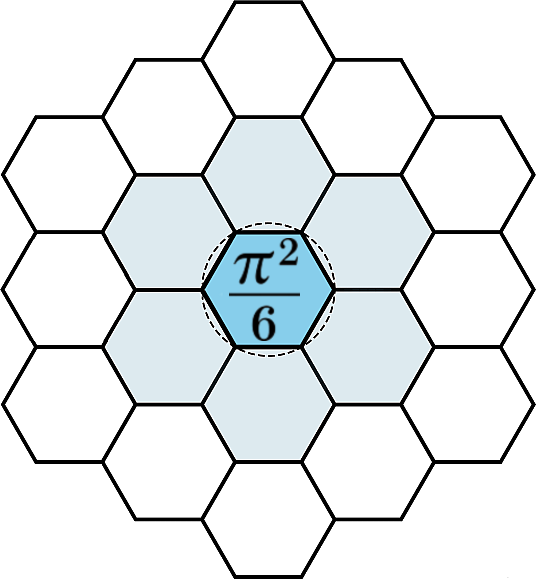
Nn(2D) = 6n
Each indexed hexagonal shell contributes six additional available
positions for every increase in shell depth.
The factor of six expresses the local hexagonal closure condition.
Each shell expands through the sixfold geometry of the underlying
architecture.
Indexed transport
Inverse-square transport weighting
Transport participation is not equally weighted at every shell.
The indexed transport law assigns inverse-square weighting:
wn =
1 / n2
Transport participation decreases with indexed shell depth.
This weighting reduces the contribution of increasingly remote
shells, but inverse-square weighting alone is not sufficient to
normalize the linear growth of flat 2D shell availability.
1D(n) participation
Depth normalization
The depth-bearing relation supplies two inseparable normalization
components:
Dn =
(1 / 6)(1 / n) =
1 / 6n
1/6 expresses sixfold local closure. 1/n expresses indexed
continuation through depth.
The factor 1/6 returns sixfold shell growth to one
locally closed contribution. The factor 1/n
introduces depth-sensitive continuation across the indexed
architecture.
The 1D(n) contribution is therefore not an arbitrary correction
added after the geometry has been constructed. It is the
depth-bearing relation that converts flat shell growth into
admissible interlayer participation.
Combined contribution
Depth-weighted shell contribution
Each shell contribution combines shell availability, inverse-square
transport weighting, and depth normalization:
ΔBn =
Nn(2D)
·
wn
·
Dn
ΔBn =
(6n)
(1 / n2)
(1 / 6)
(1 / n)
=
1 / n2
Linear shell growth is exactly cancelled by sixfold closure and
indexed depth normalization.
The contribution of each shell therefore reduces to the
inverse-square term required for convergent accumulation.
Structural comparison
Why flat 2D growth is insufficient
The difference between flat 2D transport and depth-bearing
2D + 1D(n) transport is visible in their accumulated shell
contributions.
Flat 2D shell growth
Combining shell availability with inverse-square weighting alone
gives:
(6n)(1/n2) = 6/n.
The resulting harmonic accumulation diverges.
Depth-bearing 2D + 1D(n)
Sixfold closure and indexed continuation contribute the
normalization 1/(6n), leaving the convergent
shell term 1/n2.
Within this PFT construction, depth does not merely add another
coordinate. Depth changes the admissibility and accumulated weight
of transport itself.
Convergent result
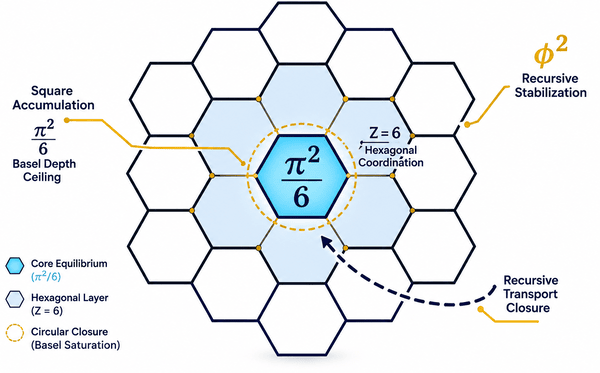
Depth-weighted Basel accumulation
Summing the normalized shell contributions produces the Basel
accumulation:
B∞ =
Σn=1∞
ΔBn
=
Σn=1∞
1 / n2
=
π2 / 6
The convergent value follows after shell growth is normalized by
local closure and admissible indexed continuation.
The appearance of the Basel value is therefore associated with a
specific construction sequence: hexagonal shell availability,
inverse-square transport weighting, sixfold closure, and indexed
depth continuation.
Construction consequence
Safe equilibrium
Safe equilibrium is the condition in which local closure is strong
enough to stabilize one bounded identity without eliminating the
continuation route required for subsequent lawful construction.
Closure without continuation would produce structural termination.
Continuation without closure would produce transport without a
stable bounded identity. The first particle must satisfy both
requirements simultaneously.
Safe equilibrium rule
Local closure + admissible continuation
The first stable particle contains the construction rule that
persists throughout the later architecture: an identity must close
sufficiently to become itself while remaining open to valid
continuation.
The First Particle Principle is not merely a statement about one early
particle. It identifies a universal construction requirement. Every stable
identity must reconcile closure with continuation, local equilibrium with
transport participation, and bounded persistence with the admissibility of
what follows.
State inheritance
Memory Is Retained State
Physical systems proceed from their current configuration rather than
retrieving an independently preserved past.
What is conventionally called memory is structured retained state that
remains available to participate in later events.
A brain, computer, archive, fossil, scar, detector, or physical system
does not retrieve the originating event itself. Its present structure
carries consequences produced through earlier transitions.
The universe has no more memory than GitHub has. It contains a present
state structured by prior operations.
Earlier events remain causally relevant because they changed the
identities, relations, boundaries, and transport conditions inherited
by the present event.
Execution architecture
From structural availability to physical expression
Pattern Field Theory treats physical manifestation as the result of a
dependency-ordered construction. An identity cannot simply appear,
interact, or persist because a mathematical description permits it.
The required transport route, coupling condition, commitment mechanism,
interlayer participation, and continuation support must first be
structurally available. The sequence below is irreversible with respect
to each completed stage.
Structural availability
The substrate must contain an admissible route through which the
proposed identity or transition can participate. Structural
availability includes the relevant boundaries, transport capacity,
layer relations, and local conditions required for an operative
process to begin. On the Allen Orbital Lattice this appears as open
admissibility corridors and stabilisation basins.
Engineering reading: Substrate prepared. No pathway
exists → process cannot begin.
Admissible coupling
The participating identities must be capable of coupling without
violating their dimensional, structural, transport, conservation, or
boundary conditions. A relation is not physically available merely
because two terms can be placed together in an equation. Coupling
remains provisional until the local geometry and transport weighting
permit a non-destructive interface.
Engineering reading: Interface matching complete.
Destructive or non-physical coupling → relation rejected.
Identity commitment
An admissible possibility becomes an operative event through bounded
commitment. The transition proceeds from an uncommitted condition to a
realised state, after which the resulting configuration becomes part
of the state inherited by later transport. Commitment is irreversible
with respect to the event that produces it.
Engineering reading: State lock executed. Provisional
or reversible state → no lasting identity.
Interlayer participation
The committed identity acquires depth-bearing participation through
coupling across transport layers. This is the condition represented in
PFT by 2D + 1D(n): flat relational transport together
with interlayer identity coupling. Without the 1D(n) depth relation,
transport lacks the depth-bearing coupling required
for measurable manifestation.
Engineering reading: Depth channel active.
Flat transport only → identity remains non-manifesting.
Manifestation and continuation
The identity becomes measurably present through the collective
physical expression of its committed relations. Continued
manifestation requires those defining relations to remain supportable
through later transport, coupling, and state transition. Gravity is the Transport through which admitted
physical states continue, inheriting the accumulated
relationships and directional conditions established
by preceding construction.
Engineering reading: Observable output + sustained
coherence. Transient signal only → identity collapses.
The sequence is a construction dependency. Each later stage requires the
conditions established by the earlier stages. Every Universal Event traverses this ordered path
from structural availability to physical expression.
Depth-bearing manifestation condition:
2D + 1D(n) ≡ Interlayer Identity Coupling (IIC)
≡ Manifestation
Research architecture
What Pattern Field Theory investigates
Pattern Field Theory investigates the operational architecture of physical
construction. Its subject is what must be constructed, maintained, coupled,
committed, and continued for physical identities and their measurable
behaviour to exist.
Manifested organization
From committed events to observable physical structure
PFT investigates how populations of committed Universal Events accumulate
into persistent physical identities and larger organized systems.
Manifestation, retained state, transport history, interlayer coupling,
and Basin Dynamics determine how these structures continue and interact.
Observable physical behaviour is therefore approached through the
accumulated state of the participating identities and the transport
conditions available to them at each subsequent event.
How do committed Universal Events accumulate into the persistent,
measurable physical structures observed across scale?
Operative constraints
Transport and admissibility
Transport is treated as structurally allocated participation rather
than unrestricted motion through an empty background. Every
transition requires an available route, compatible identities, a
valid interface, and sufficient structural support.
Admissibility determines which couplings, interactions, transitions,
and continuations can occur under the conditions present. A formally
expressible process is not automatically a physically realisable
process.
Which transitions are constructible, and which are excluded by the
actual transport and coupling conditions?
Bounded physical identity
Identity, persistence, autonomy, and retained state
PFT investigates how a bounded identity can remain recognisably the
same identity while participating in successive events. Persistence
is not treated as automatic endurance. It requires the continued
maintenance of the relations that define the identity.
Once an identity is sufficiently bounded to persist, it also acquires a
degree of local autonomy: the capacity to respond to local conditions,
maintain its defining relations, and continue without every change requiring
intervention from the larger structures in which it participates. This
autonomy remains constrained by admissibility, available transport, and the
conditions of the accumulated identity.
Retained state is the present structural consequence of earlier
transitions. A physical system does not need access to an independently
preserved past. Its current configuration carries the changes produced
by prior commitments and therefore changes what later transport can do.
How does a bounded identity maintain itself, respond locally, retain
defining relations, and continue through later events?
Chain of Structural Identities
The Traceable, Un-Dialed Chain of Structural Identities
- Nm = 6m is not a parameter. It is the geometric property of regular hexagonal packing on a discrete shell.
- Dm = m is forced after one physical identification: one complete six-node closure is one IIC depth unit. Then Dm = Nm/6 = m.
- Am = m2 is forced by mlateral = 6m and Dm = m. It was in the EQUI engine before the next identity was isolated.
- ΔAm = 2m+1 is the algebra of squares, recognized after Am was already infrastructure.
- Um = 6(2m+1) is an independent frontier port-count. Um = 6ΔAm is a geometric identity, not a calibration.
- ri = Pi+1/Pi is invariant under P → λP. The scale cancels identically.
- HD 110067 in the extreme tail across 48 settings versus matched nulls is empirical persistence under the stated audit. p/q is the Rationic marker, not an AOL closure certificate.
Constructive mechanics
Interlayer identity coupling as a depth unit
Interlayer identity coupling is the depth-bearing operation in Pattern
Field Theory. Written as 2D + 1D(n), it is the
condition that converts flat relational transport into persistent,
measurable identity. The depth unit is how that operation is counted.
On the Allen Orbital Lattice a completed six-node closure is identified
as one IIC depth unit. Combined with the hexagonal shell law
Nm = 6m, the count is forced:
Dm = m.
That identification is the only non-geometric joint in the chain.
After it, the rest is algebra.
“Interlayer” is not a second axis drawn on the hex board. It couples two
already-present structures: a lateral sixfold closure, and an identity
registration that can persist into the next accepted configuration. A
depth unit is not a metre inward. It is one admitted coupling event.
Forced count.
One complete six-node closure = one IIC depth unit.
Therefore Dm = Nm/6 = m.
Effect.
Successor support increases by one depth step.
The local count resets to 0new.
The admitted coupling contributes to persistent manifested
identity. Gravity is identified separately with the
underlying Transport process.
Geometry
Shell law before coupling
Regular hexagonal packing on a discrete shell gives
Nm = 6m.
This is not a parameter. It is the occupancy of shell
m.
“Six completes. Seven continues.” A completed six is eligible for
coupling. An unclosed seventh direction is not a depth unit. It
remains frontier labour until another six is complete.
Geometry supplies the closures. IIC decides which closures become
registered depth.
Identification
Why Dm equals m
Once one complete six-node closure is one IIC unit,
Dm = Nm/6 = m.
The same integer is the minimum radial path from the origin to
shell m. Closure count and shortest-path depth coincide.
A cumulative competitor Dmcum = m(m+1)/2
was retained in the depth experiment and rejected. It changes EQUI
exhaustion and does not match one completed closure to one unit.
Nm = 6m is geometry. The IIC identification is the only
joint that can be disputed without calling the division a fit.
Admission
A unit is not a free increment
Phase Alignment Lock tests whether the candidate coupling is
admissible. EQUI tests whether transport participation can be
allocated. Safe Equilibrium is the support floor already held.
Depth Dynamics is negotiation beyond that floor.
IIC is the coupling that increments depth only if those conditions
hold. Incomplete six, failed lock, or unfunded allocation means no
unit.
Available closure → PAL → EQUI → IIC commit →
Dm+1 = Dm+1 → 0new.
Distinction
Depth is not frontier
Completed IIC units accumulate as state support
Am = m2.
The next-state increment is
ΔAm = 2m+1.
Unresolved outward ports on the same shell are
Um = 6(2m+1) = 6ΔAm.
Depth counts accepted couplings. Frontier counts work not yet
admitted. Confusing them imports a clock or a labour total into
the depth index.
Hex shell → IIC identification → Dm →
Am → ΔAm → Um.
One admitted IIC unit performs four jobs, then resets. The previous
local count is not kept as substrate time.
Close
A six-node set completes on the Allen Orbital Lattice.
Couple
Identity is bound through that closure: 2D + 1D(n).
Register
The coupling becomes continuation support. Depth increases by one.
Reset
Availability is rewritten. The local count becomes 0new.
Locked.
An IIC depth unit is one admitted coupling of identity through one
complete six-node closure. Count: Dm = m.
Effect: successor support increases by one depth step; local count
resets. The unit is not a stored clock, not Um, not a period
ratio p/q, and not automatic particle creation.
Open as process, not as algebra.
Still required: the QUART path that realises one six-node closure as a
coupling; the identity object being coupled; whether one Actus equals
one IIC unit, or many frontier admissions precede the commit; and how
EQUI charges the unit — Am, ΔAm, or a
non-overlapping split.
Execution map.
This is Stage 04 in the existing pipeline.
2D + 1D(n) ≡ Interlayer Identity Coupling (IIC)
≡ Manifestation.
Without that stage, identities remain non-manifesting.
Pattern Field Theory mission
Derive the construction of physical reality
Pattern Field Theory seeks to identify, and is actively deriving, the physical
construction through which a universe can form, differentiate, transport,
commit, manifest, preserve identity, and continue.
The focus now is to follow physical results back to the mechanisms and
structural dependencies required to produce them. Where the Universe produces
a result, PFT asks what must exist, what must occur, what must remain available,
and what sequence of construction makes that result possible.
PFT seeks to show that the observed physical world must and can be derived
from an explicit, internally consistent architecture of construction and
continuation.
Development status
Pattern Field Theory Research Status
Pattern Field Theory has an established current architecture together
with an active programme of formal extension, mathematical
consolidation, empirical evaluation, and corpus integration.
Current formal architecture
Pattern Field Theory
These structures define the present formal architecture through which
PFT explains universal construction, identity, transport,
manifestation, gravitation, and effective physical behaviour.
- Identity Dynamics with Manifestation
- Universal Event architecture
-
2D + 1D(n) interlayer identity coupling
-
Gravity as Transport - relational continuation,
inherited directional state, acceleration, and free fall
-
Safe equilibrium through local closure and admissible continuation
-
First Particle Principle and universe-seeding Base-Pi capacity
-
Allen Orbital Lattice as the principal discrete admissibility lattice in the PFT transport architecture
Active formal development
Extending and strengthening the framework
Current research develops the mathematical, particle-scale,
continuum-scale, and empirical consequences of the established PFT
architecture.
-
Derivation of continuum regimes from populations of Universal Events
-
Particle and field derivations from the PFT construction architecture
-
Quantitative identities and measurement correspondence
-
EQUI transport allocation architecture
-
Particle, atomic, and orbital derivations
-
Complete mathematical dependency and construction chain
Corpus consolidation
Integrating the complete research history
Earlier research materials are being preserved, classified, and
brought into explicit correspondence with the current formal
architecture.
-
Harmonization of earlier terminology with current definitions
-
Re-expression of earlier cosmological work through the present
architecture
-
Versioning and replacement mapping for earlier equations
-
Alignment of earlier wording with current definitions
-
Classification and reintegration of the article corpus
Pattern Field Theory preserves both its current architecture and its documented development history. Earlier materials remain part of the research record, with later formulations recording subsequent refinement and extension.
Engineering applications
Interlayer identity coupling in applied systems
Interlayer identity coupling (the PFT structural condition expressed as
2D + 1D(n)) is the depth-bearing relation that converts
flat relational transport into persistent, measurable identity. In the
framework it establishes the depth-bearing condition for
manifestation. Gravity is Transport, with admissible
continuation operating through inherited physical state
and accumulated identity.
Materials
Layered materials and heterostructure design
Layered materials provide an applied environment in which coupling,
persistence, transport, and identity continuity across depth can be
investigated as explicit engineering variables within the PFT framework.
Practical implications include designing heterostructures so that an
identity (charge packet, exciton, or spin texture) remains recognisably
the same entity after interlayer transfer rather than dissolving into
a new collective mode; using the hexagonal Allen Orbital Lattice
geometry as a target lattice symmetry for substrate or moiré
engineering; and treating “manifestation failure” (loss of coherent
identity after interlayer hop) as a measurable design defect,
analogous to decoherence or interface scattering.
Materials whose interlayer coupling is engineered for persistence of
relational identity, not only for mobility or optical response.
Computing
Multi-layer and depth-aware architectures
Multi-layer computing provides an applied architecture in which an
operative identity can be tested for coherence, persistence, and retained
state while participating across functional layers.
Directions include neuromorphic or reservoir-computing substrates in
which a pattern is committed across a depth dimension so that later
layers inherit a retained state; quantum or hybrid architectures in
which logical identity is required to survive interlayer transport;
and fault-tolerant designs that treat loss of interlayer coupling as
loss of identity, triggering controlled re-commitment rather than
simple error correction of bits.
The engineering metric becomes “identity retention across depth”
rather than only bit-error rate or latency.
Soft systems
Morphogenesis, self-assembly, and soft systems
PFT papers on 2D-to-3D morphogenesis and ferrofluid labyrinths already
treat form as the result of committing a 2D pattern field through a
1D depth-binding operation.
Engineering translations include soft-robotic or programmable-matter
systems whose shape change is governed by controlled interlayer
coupling; self-assembling materials in which the transition from
planar pattern to three-dimensional structure is treated as an
identity-commitment event; and bio-inspired fabrication in which
regeneration versus fibrosis is modelled as shallow versus deep
locking of the same pattern identity.
Local closure and admissible continuation must both be present, or
the structure either collapses or fails to stabilise.
Sensing
Sensing and state-tracking systems
If manifestation requires interlayer identity coupling, then sensors
that detect the presence of a coherent identity across layers become
a natural target class.
Multi-layer sensors can register a signal only when a depth-bearing
coupling condition is satisfied. Structural-health systems can treat
loss of interlayer coherence as an early indicator of failure.
Distributed sensor networks can report an entity only while its
defining relations remain coupled across successive measurement
layers or time steps.
Identity continuity becomes the detection criterion.
Transport
Transport and constrained-flow systems
PFT treats transport as structurally allocated participation rather
than free motion through an empty background. Interlayer identity
coupling then becomes a constraint on which transport routes can
support persistent identities.
Network designs can allow an identity to continue only when a
depth-compatible coupling condition is met. Energy or information
systems can distinguish flat (non-manifesting) corridors from
depth-bearing corridors. Control systems can declare a transition
physically realisable only after the required interlayer participation
is verified.
Admissibility filters become part of the control logic.
Applied reading.
Interlayer identity coupling is the same 2D + 1D(n) operation
used in the architecture: identity persists only when a completed
depth-bearing coupling is admitted.
Engineering metric.
Identity retention across depth. Loss of that coupling is loss of the
bearer, not a mere interface loss.
Execution architecture
Dependency map - ordered construction pipeline
The Execution architecture is a strict, ordered construction pipeline.
Each stage is a precondition for the next; later stages cannot be invoked
while earlier conditions remain absent.
Structural availability
Admissible route, boundaries, transport capacity and layer relations
must already exist on the substrate.
Engineering analogue: Substrate prepared with open
corridors, stabilisation basins and correct lattice geometry
(hexagonal preferred).
Failure mode: No pathway exists → process cannot begin.
Admissible coupling
Identities can interface without violating dimensional, structural,
transport or conservation constraints.
Engineering analogue: Interface matching (impedance,
symmetry, conservation) between participating elements.
Failure mode: Destructive or non-physical coupling →
relation rejected.
Identity commitment
Bounded transition from possibility to realised state; the resulting
configuration is now inherited by later transport.
Engineering analogue: Commit / lock operation that
changes system state for all subsequent stages.
Failure mode: Reversible or provisional state → no
lasting identity.
Interlayer participation
Depth-bearing coupling across transport layers
(2D + 1D(n)). Flat 2D transport alone is insufficient.
Engineering analogue: Active interlayer channel that
maintains relational identity across depth.
Failure mode: Flat transport only → identity remains
non-manifesting.
Manifestation and continuation
Measurable physical expression plus sustained support of the defining
relations through subsequent events.
Engineering analogue: Observable output + sustained
coherence under later transport.
Failure mode: Transient signal only → identity
collapses or fails to persist.
Key structural invariants
The sequence is dependency-ordered. Stage 05 cannot produce a stable
physical identity if any prior stage is missing. Stage 04 is the critical
transition: it is the point at which flat relational transport becomes
depth-bearing and therefore capable of manifestation. Interlayer coupling establishes depth-bearing manifestation.
Gravity is Transport, with physical continuation governed
by admissibility and the inherited state of accumulated identities.
Depth-bearing manifestation condition:
2D + 1D(n) ≡ Interlayer Identity Coupling (IIC)
≡ Manifestation
Research corpus
Current work and documented development
The PFT corpus preserves current work together with the documented development of
terminology, definitions, equations, dependencies, derivations, revisions, and publication history.
Research status
Active programme
Publications online
Authorship and provenance
Author
Pattern Field Theory is authored by James Johan Sebastian Allen, also
publishing as James J. S. Allen, and J.J.S.Allen.
Research records
PFT Zenodo community, and the author's
Academia.edu research profile.