Black Hole Regimes and Transport Saturation
Pattern Field Theory defines black holes as extreme transport and basin saturation regimes within the Allen Orbital Lattice.
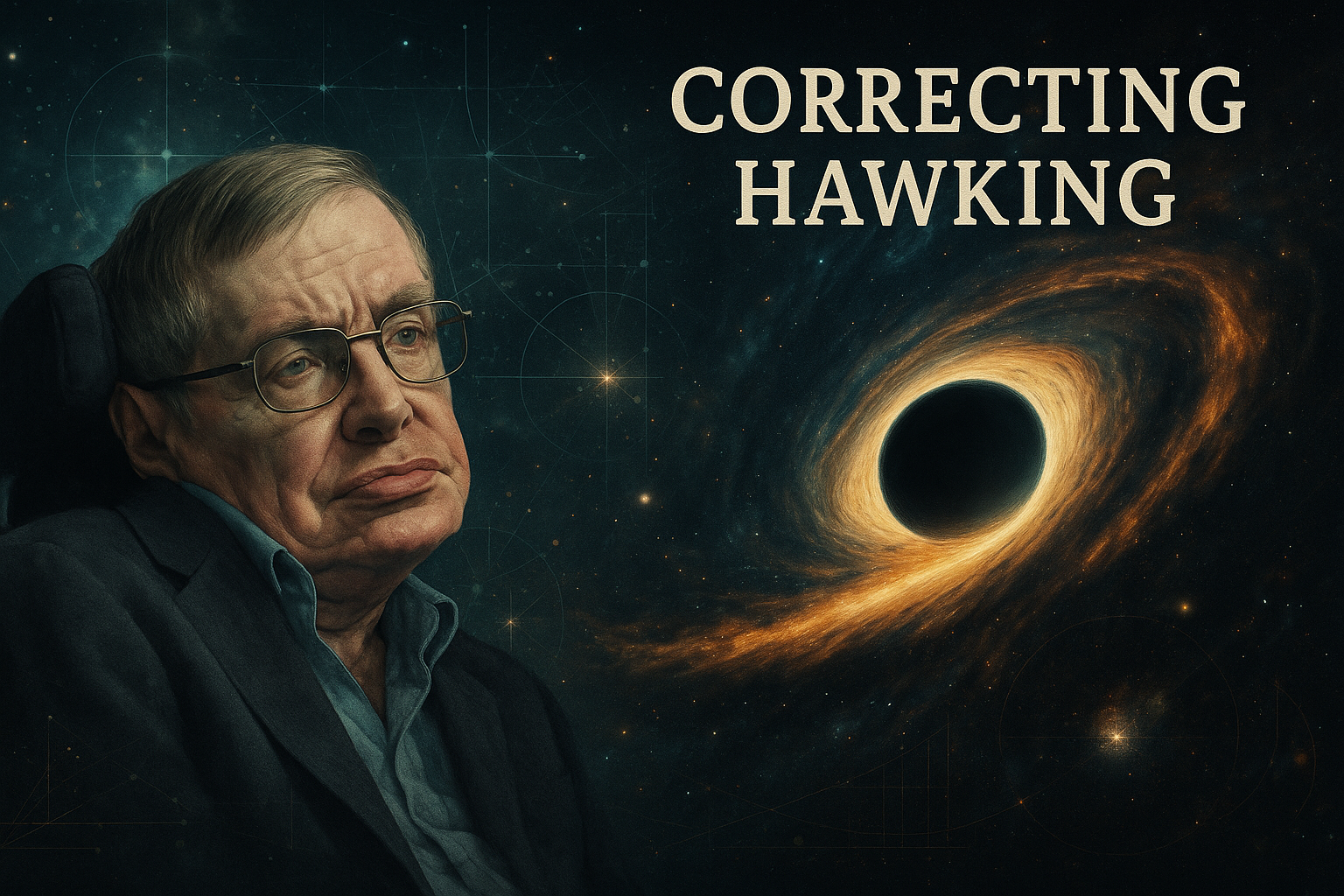
Breakdown of the Continuum Model
Standard black hole theory produces singularities, information paradoxes, and non-physical infinities. These arise from modeling reality as a continuous manifold under extreme curvature.
Pattern Field Theory replaces the continuum with a discrete transport substrate. All physical behavior is governed by lattice structure, phase alignment, admissibility, and basin constraints. Under this model, singularities do not exist as physical objects.
Transport and Basin Saturation
Black holes correspond to regions where transport capacity is exceeded and basin saturation occurs. Incoming structure cannot propagate through the local lattice at ordinary rates and instead accumulates, forcing the system into a constrained high-density regime.
- Transport pathways become saturated
- Closure density increases
- Admissible transitions become restricted
- The system enters a regime shift rather than a collapse
No Singularities
The singularity is replaced by a finite structural limit defined by basin capacity and transport constraint. There is no infinite density. There is no breakdown of law. The system remains governed by admissible transitions within the lattice.
What appears as a singularity in continuum models is a regime boundary in Pattern Field Theory.
Information Continuity
Information is never destroyed. Pattern states are preserved through constrained transformation, redistribution, and delayed propagation across the lattice.
The information paradox arises from assuming that structure can terminate. In Pattern Field Theory, all structure remains within the field and continues to evolve under transport and coherence constraints.
Radiative Release as Boundary Relaxation
The outward radiation associated with black holes is a boundary effect. It arises from phase imbalance and structural tension at the edge of a saturated regime.
This relation describes observable behavior but does not define the underlying mechanism. In Pattern Field Theory, the emission is a relaxation process driven by transport imbalance, closure pressure, and boundary reconfiguration.
Regime Transition
Black holes are not endpoints. They are regime transitions within the lattice.
- Low-density transport regime → standard propagation
- High-density regime → constrained transport and accumulation
- Saturated regime → boundary-driven release and structural redistribution
The system remains continuous across these regimes. Only the transport rules and admissibility conditions change.
Observer Pattern and Accessibility
The observer pattern does not detect internal structure beyond a regime boundary due to transport limitations. This creates the appearance of information loss.
The limitation is observational, not structural. The underlying system remains intact and governed by the same laws.
Structural Summary
- No singularities - replaced by finite basin saturation limits
- No information loss - replaced by constrained redistribution
- No continuum breakdown - replaced by discrete transport regime transition
- No paradox - replaced by incomplete modeling assumptions