Rubakov’s Field Theory & Standard Model vs Pattern Field Theory
Structural translation using Rosetta Layer correspondence
Authorship
Author: James Johan Sebastian Allen
Framework: Pattern Field Theory (PFT)
Purpose: Ontological and structural comparison between continuous field physics and discrete substrate transport physics.
Author: James Johan Sebastian Allen
Framework: Pattern Field Theory (PFT)
Purpose: Ontological and structural comparison between continuous field physics and discrete substrate transport physics.
1. Ontological Level Distinction
| Aspect | QFT / Standard Model | Pattern Field Theory |
|---|---|---|
| Primitive | Continuous fields | Discrete structural substrate |
| Particle meaning | Field excitation | Stable closure state |
| Constants | Fundamental invariants | Emergent stability ratios |
| Mass origin | Higgs scalar coupling | Closure geometry |
| Divergence control | Renormalization | Differentiat reset |
| Light propagation | Velocity constant | Coherence transport rate |
2. Rosetta Translation Mapping
- Field → resonance mesh
- Particle → closure state
- Gauge symmetry → harmonic invariance
- Renormalization → admissibility recalibration
- Scalar mass generation → geometric closure stability
3. Structural Transport Laws in PFT
- Φλ ≈ Δφ / τₚ — coherence transport rate
- TRM redshift decomposition
- Λ–Φ harmonic scaling
- Triadic closure engine: Pi / primes / Phi
4. Structural Embedding
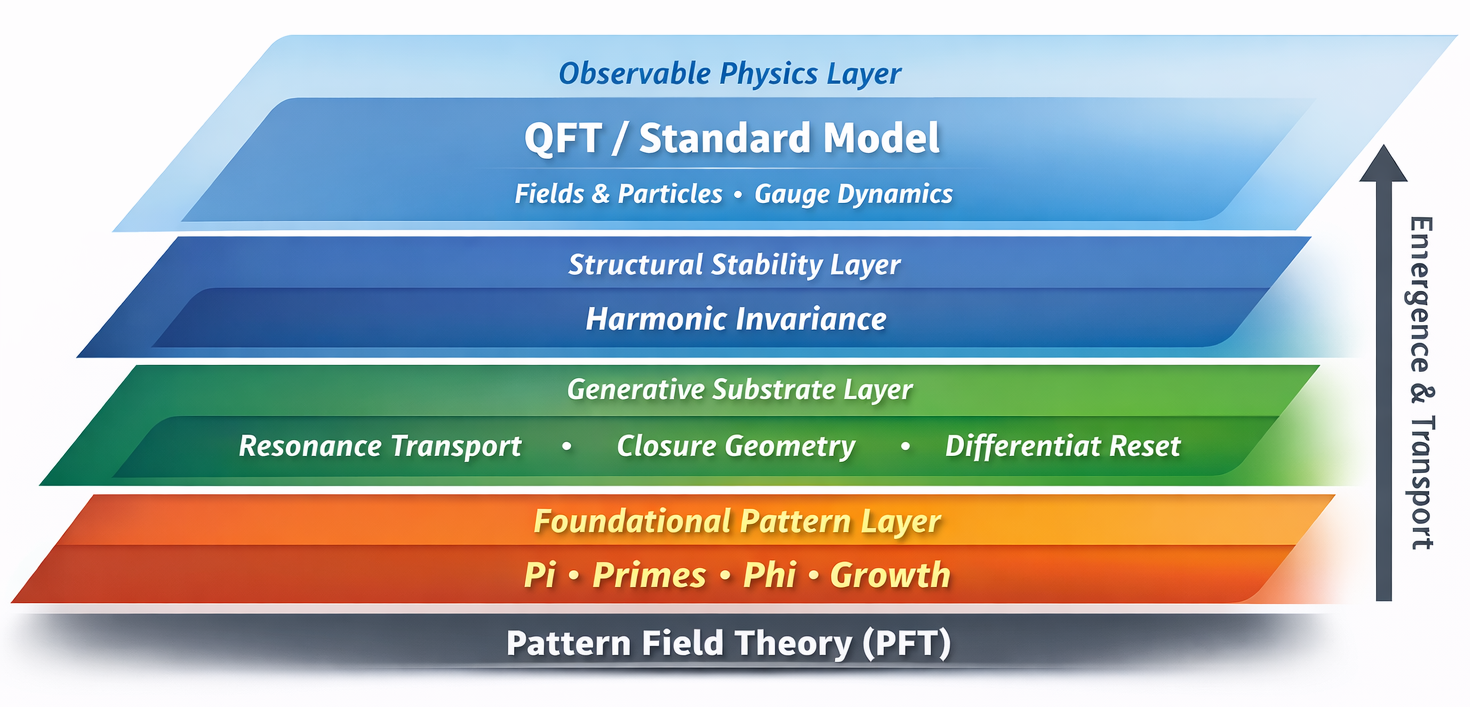
The Standard Model describes interactions within established structural stability. Pattern Field Theory describes the generative mechanism that produces those stable structures.
5. Distinct Predictive Structure
- Multi-component redshift separation
- Rotational coherence transport
- Cross-domain harmonic scaling bands
- Mass hierarchy from closure topology
6. Ontology Layer Diagram
7. Structural Conclusion
Quantum Field Theory and the Standard Model provide a consistent interaction framework operating within stable structural regimes.
Pattern Field Theory defines the discrete transport substrate responsible for the formation, maintenance, and transformation of those regimes.
The frameworks therefore address different layers of physical description:
- QFT / SM — interaction behaviour
- PFT — structural admissibility and emergence
Reference
Rubakov, V. (2009). Field Theory and the Standard Model. Cambridge University Press.